The World's first practical
Johnson Noise Thermometer
Developed by Metrosol Limited
Primary Thermometers that don't drift
Measuring temperature directly using the fundamental properties of thermal fluctuations in conductors.
Since starting in 2014, we have developed a completely new technique for measuring Johnson Noise.
2017 - 2020
Development of the core technology for the World's first practical Johnson Noise Thermometer, capable of working up to 1,000°C
2021
Have sourced all of the necessary technology required to produce a commercial Johnson Noise Thermometer
The Johnson Noise Thermometer
Johnson noise thermometry (JNT) is a primary temperature measurement technique based on the fundamental properties of thermal fluctuations in conductors.
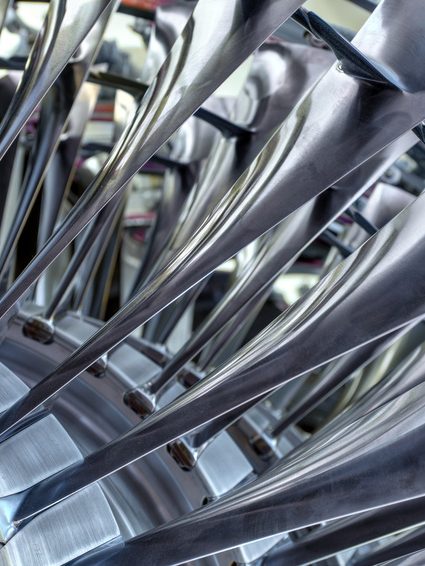
A Johnson noise thermometer never needs calibrating and is insensitive to the condition of the sensor material, so is ideally suited to long-term temperature measurements in harsh environments (such as nuclear reactor coolant circuits, nuclear waste management and storage) or where low drift is required (such as high temperature reference standards in metrology or the annealing of single crystal turbine blades in the aerospace industry).
Why use one?
At present all thermometers in use (thermocouples, platinum resistance thermometers, thermocouples) are secondary thermometers and are therefore prone to drift. They don’t actually measure temperature directly, instead a property of the sensor (such as resistance or EMF) is measured. The property is related to temperature by a calibration process. Either the generic relationship between the property and temperature is used or an individual calibration can be made if greater accuracy is required. In use, this relationship is employed to convert the measurand back to temperature, but this assumes that the relationship has not changed. In practice, this relationship between the property and temperature can change with time leading to “drift” in the reported temperature. This is particularly so in harsh environments where factors such as contamination of the sensor, changes in its physical structure, strain or transmutation (in nuclear environments) affect the property measured independent of its temperature.
Primary thermometers are quite different. With a primary thermometer, all the required properties of the sensor are measured and then fed into a fundamental physical law from which true thermodynamic temperature can be calculated.
Because the measurement of temperature is based on a fundamental physical law, primary thermometers do not (cannot) drift. Of course, the electronics used to measure the required properties can drift, but modern electronics are more than adequate to ensure that such drift is insignificant. In current practical thermometers, it is always the sensor rather that the electronics that give rise to the drift.
What is Johnson Noise?
Johnson noise (thermal noise, Johnson-Nyquist noise, white noise) is the electronic noise generated by the thermal agitation of the charge carriers (usually the electrons) inside an electrical conductor, which happens regardless of any applied voltage. The generic, statistical physical derivation of this noise is called the fluctuation-dissipation theorem.
Johnson noise in an ideal resistor is white, meaning that the power spectral density is constant throughout the frequency spectrum (except at extremely high frequencies). As the Johnson noise is the results of many independent charge carrier movements, the central limit theorem states that the resulting noise voltage will have a normal or Gaussian distribution.
The most important aspect of Johnson noise from our point of view is that the power of the Johnson noise is directly proportional to absolute temperature. There is no material property or calibration requirement to derive the absolute temperature, just electrical measurements. Therefore, this technique is not subject to sensor drift.
What makes Johnson Noise drift free?
By measuring the Johnson noise in a resistive sensor together with the sensor resistance and measurement bandwidth, the Johnson-Nyquist equation can be used to the determine true thermodynamic temperature of the sensor completely independent of the state of the sensor itself:
Why don't all thermometers use Johnson Noise?
The Johnson noise signal is extremely small (comparable to the electrical noise in the best low-noise amplifiers), making it extremely difficult to measure with sufficient precision and also easily contaminated by electrical noise in the environment. Many attempts to make a practical JNT have been made since the arrival of modern electronics era in the late 1950s, but none have so far led to a commercial product due to the difficulties associated with the low signal levels and the contamination of the signal by external noise.
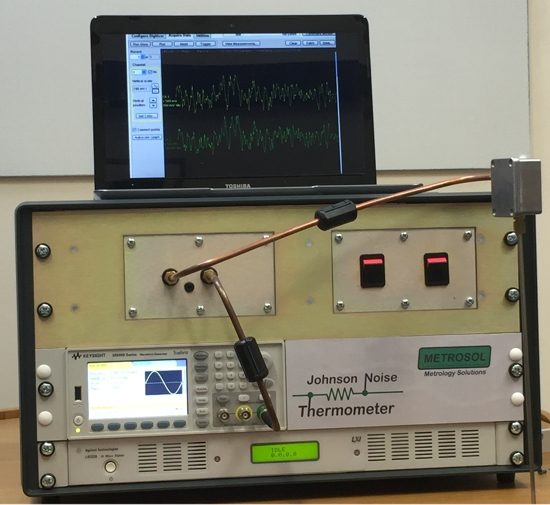
Metrosol in collaboration with the National Physical Laboratory (NPL) are developing the world’s first practical Johnson Noise Thermometer. This work started in 2014 with a scoping and feasibility project, which lead to a completely new technique for measuring Johnson noise that was then patented and a demonstrator/proof of principle prototype. The demonstrator operated over the range -20 to 120°C, used several commercial instruments in order to make the measurements and weighed in at 35kg in a 70L volume.
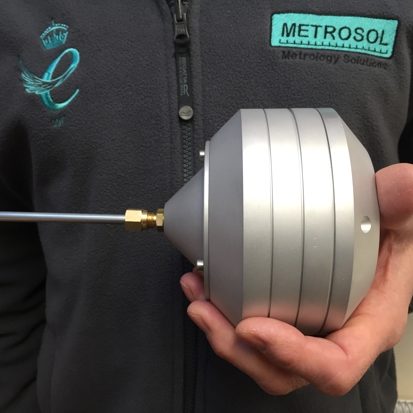
Between 2017 and 2020 we developed all the core technology (electronics, software, mechanics/enclosure, high temperature probe) required to realise a commercial thermometer capable of working up to 1,000°C in a practical format (1kg and 1L).
One of the most notable achievements of this phase was that when the prototype was tested for EMC (electromagnetic compatibility), it was shown to be completely immune to external electromagnetic radiation up to the heavy industrial limits as specified in EN61000-4-3.
In 2021 we have been characterising all the JNT sub-systems in order to optimise the design and produce a comprehensive uncertainty budget for the thermometer. By the end of 2021 we will have all the technology required to produce a commercial Johnson Noise Thermometer and will start to work with potential adopters on the development and production of the first commercial product using this new technology.